
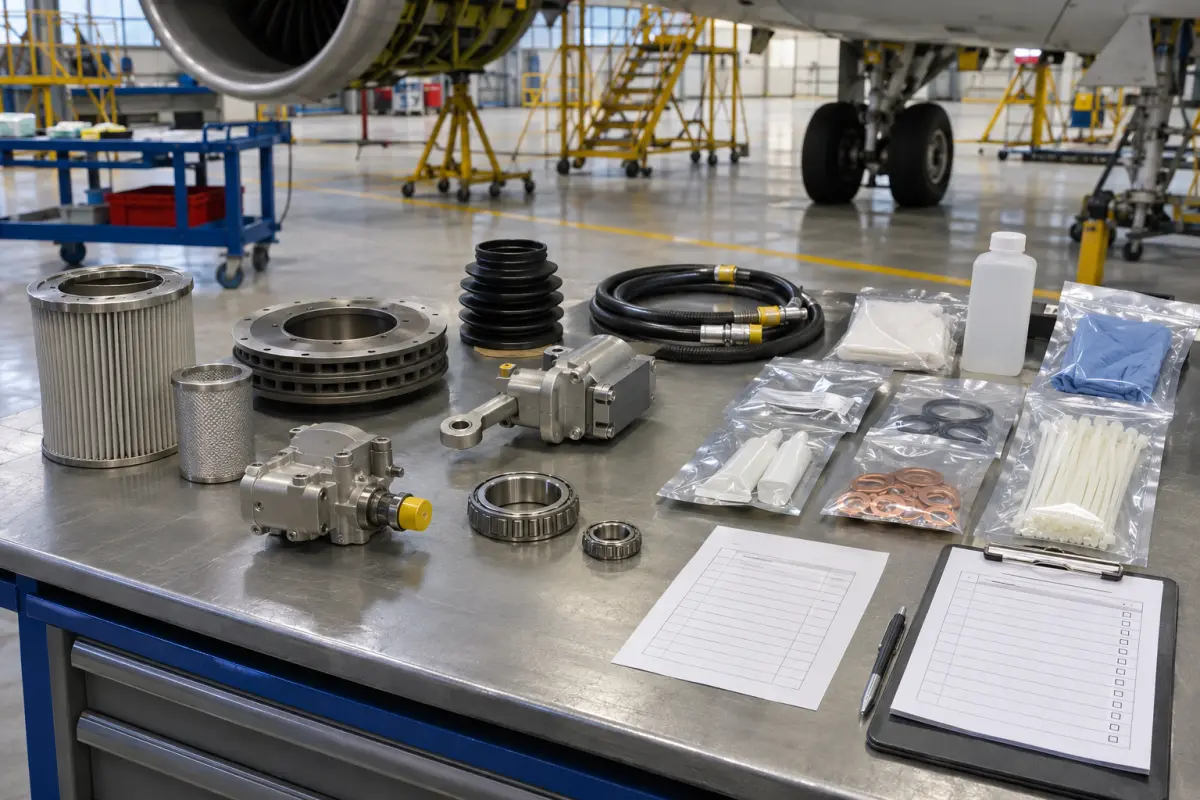
Aircraft Spare Parts Supplier Checklist for MRO Buyers
An aircraft spare parts supplier checklist helps MRO buyers verify that a quoted item is the right part, in the required condition, with the documentation needed to receive and evaluate it. Start with the exact part number and revision, then check traceability, paperwork, packaging, and the supplier’s ability to quote against your complete request.
Key Takeaways
- Match the quoted part number, revision, and condition to the purchase request.
- State documentation requirements before requesting a quote, not after shipment.
- Ask how the supplier will identify the source and preserve traceability.
- For shelf-life-controlled materials, request lot and expiration details.
- Resolve substitutions and discrepancies before issuing a purchase order.
1. Confirm Exactly What Part You Need
A supplier cannot reliably match a request that says only “aircraft bracket” or “hydraulic fitting.” Provide the manufacturer’s part number as recorded in the applicable parts data, including its full suffix and revision when relevant. State the aircraft or assembly context separately; a model name is useful context but is not a substitute for an item identifier.
For each line item, record:
- Part identity: Exact part number, manufacturer if specified, and any required revision or configuration.
- Quantity and unit: Distinguish each, kit, set, roll, or other purchasing unit.
- Condition: Specify whether the request is for a new, repaired, overhauled, or other acceptable condition, as applicable.
- Alternates: State whether the supplier may propose an alternate and require it to be identified separately.
- Use context: Include the aircraft, engine, assembly, or maintenance task when it helps prevent a mismatch.
An NSN may help identify a supply item, but buyers should still check the requested part number and configuration. See CraftJetAero’s guide to NSN numbers for aviation buyers if your request includes both identifiers. For categories such as aircraft components, the identifier and condition are especially important because similar descriptions can refer to different items.
2. Define Traceability and Documentation Requirements
Ask what records will accompany the item and what those records will establish. Traceability is most useful when a buyer can connect the delivered item’s identifying marks and packaging to the supplier’s paperwork and the stated source. A document title alone does not tell you whether the record covers the particular item being offered.
| Checklist item | Question to ask the supplier | What to compare at receipt |
|---|---|---|
| Item identity | What part number, revision, serial number, or lot number applies? | Item marks, packaging, quote, and paperwork |
| Source | What source information can you provide for this item? | Source details against the records supplied |
| Condition | What condition is being quoted, and how is it documented? | Quoted condition against accompanying records |
| Requested documents | Can you supply the specific records named in our purchase order? | Documents received against purchase-order requirements |
Documentation needs differ by item, transaction, and buyer procedure. Instead of asking for “all paperwork,” list the records your receiving team needs and ask the supplier to confirm which will be supplied. If a quoted item is serialized or lot-controlled, request the applicable identifier so receiving can reconcile the item with its records.
3. Assess the Supplier’s Quote and Discrepancy Process
A useful quote answers more than “Can you supply it?” It identifies what is being offered and makes exceptions visible. Compare the quote line by line with your request, particularly when multiple quantities, conditions, or manufacturers are involved.
- Does the quote repeat the requested part number and clearly identify any different part number offered?
- Are manufacturer, revision, condition, quantity, and unit of measure stated where applicable?
- Does the supplier confirm which requested documents can accompany the item?
- Are packaging or preservation requirements acknowledged if your purchase order specifies them?
- Is there a clear route for resolving an identification or paperwork discrepancy before the order is placed?
Keep the approved request, supplier quote, and purchase order aligned. If a supplier proposes an alternate, record it as an alternate rather than silently replacing the requested line. That distinction gives engineering and procurement a clear item to evaluate and prevents an ambiguous purchase-order description.
4. Add Controls for Chemicals and Consumables
The same checklist can cover items beyond repairable components, but the questions change. A fastener request may depend on exact size, material, finish, and part identification; a sealant request may also need package size, lot information, and usable life. Treat a broad description such as “tape” or “primer” as a starting point, not a complete purchasing specification.
For shelf-life-controlled chemicals, ask for the lot or batch identifier, expiration information, and any documentation needed to evaluate the remaining usable life at receipt. Storage and shipping requirements may also affect whether an offer meets your request. CraftJetAero’s aerospace chemical shelf-life guide explains the buying questions in more detail. For hardware, its aircraft fasteners guide provides context for identifying what to request.
Confirm approvals, substitutions, and airworthiness against the applicable aircraft maintenance documentation and your organization’s procedures; for chemicals and other formulated products, follow the manufacturer’s data sheet as well. A supplier quote or general product description does not, by itself, establish suitability for a particular maintenance task.
5. Send an RFQ That Can Be Checked Line by Line
A structured request for quotation (RFQ) makes supplier responses easier to compare. Put one distinct item and condition on each line, attach or list the required documents, and ask the supplier to call out any exceptions. Include your receiving requirements early so they can be addressed before a purchase order is issued.
For example, a buyer could write: “Please quote the manufacturer’s part number shown on our attached purchase request, quantity two each, in new condition. Confirm the complete part number and revision offered, manufacturer, available source and traceability records, documentation that will accompany the items, and any exception to our stated packaging requirements. Quote any proposed alternate on a separate line.” This example uses no assumed part number and gives the supplier a clear basis for a comparable response.
Before placing the order, check the response against the RFQ: Are the identifier and condition unchanged? Are documentation commitments explicit? Have alternates and exceptions been reviewed? Record the agreed requirements on the purchase order so receiving has a practical standard against which to check the delivery.
Sourcing from CraftJetAero
CraftJetAero buyers can request a quote by part number. Include the quantity, condition, manufacturer or revision requirements, and any documents or packaging details needed for your review.
Frequently Asked Questions
What is the first item on an aircraft spare parts supplier checklist?
Verify the exact requested part number, including any suffix or revision that matters to the request. Then check that the supplier’s quote identifies the same item or clearly labels a proposed alternate.
Is an NSN enough to order an aircraft part?
An NSN can help identify a supply item, but it should not replace a check of the required part number, configuration, and condition. Provide both identifiers when they are available and relevant to your request.
What traceability should I request?
State the source and item-identification records your receiving process needs. Ask the supplier to identify which records will accompany the offered item, particularly when it has a serial or lot number.
Should a supplier be allowed to quote an alternate part?
You can invite alternates if your process permits them, but require each alternate to be identified separately from the requested part. Resolve its acceptability before putting it on a purchase order.
What changes when sourcing aviation chemicals?
In addition to exact product identification and package size, ask for lot information and expiration details when shelf life applies. Include any receiving, storage, or shipping requirements in the RFQ.