
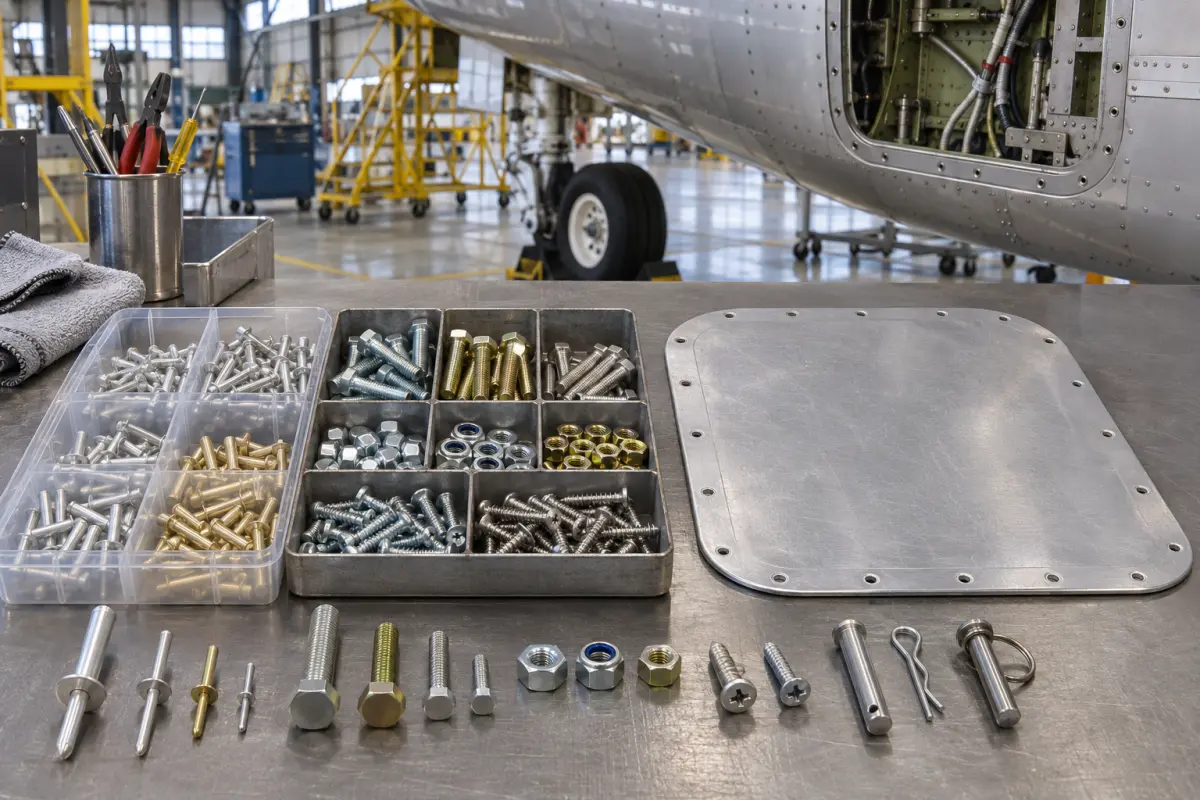
Aircraft Fasteners Types: A Practical MRO Buying Guide
Aircraft fasteners types include rivets, bolts, nuts, screws, pins and specialty hardware used to join or retain aircraft parts. The right type depends on the joint design, required strength, access for installation and removal, and the exact hardware identified in the aircraft maintenance documentation.
Key Takeaways
- Rivets form permanent joints; bolts and screws generally allow disassembly.
- A fastener family does not identify a replacement: diameter, length, material, head and installation details also matter.
- Blind rivets are installed from one side; solid rivets typically require access to both sides.
- Procurement should begin with the specified part number and any documented interchangeability, not a visual match.
Common Aircraft Fastener Types and Their Uses
Aircraft hardware spans permanent joints, removable joints and devices that retain other components. The categories below describe how fasteners generally work; they do not make individual parts interchangeable. Even within one category, differences in geometry, material and installation method can change how a joint performs.
| Fastener type | Typical function | Practical distinction |
|---|---|---|
| Solid rivet | Forms a permanent joint in sheet-metal assemblies | Usually needs access to both sides for installation |
| Blind rivet | Forms a permanent joint where rear-side access is limited | Installed from one side; designs are not interchangeable by appearance |
| Bolt and nut | Clamps parts in a removable joint | Grip length, thread engagement and retention method matter |
| Screw | Secures a removable panel or component | Head, drive, thread and mating material must match |
| Pin | Locates a part or retains a joint, depending on design | Installation and retention method vary by pin type |
| Specialty fastener | Serves a particular joint or access requirement | May require dedicated installation tools and inspection criteria |
Solid rivets are common in permanent sheet-metal joints because the installer forms a second head after placing the rivet. Blind rivets address situations where tooling cannot reach the back of the joint. A maintenance request for a blind rivet therefore needs more than a diameter: the specified design and grip range are important.
Bolts and nuts are used where a joint must be clamped and may need later disassembly. Screws also permit removal, but the word “screw” covers different head styles, drives and thread arrangements. Pins may locate parts, act as pivots or provide retention; a cotter pin, for example, serves a different purpose from a pin designed to carry a joint load. Buyers looking for related items can browse CraftJetAero’s aviation consumables and hardware category.
How Installation and Access Narrow the Choice
The first useful question is what the joint must do. A permanent sheet-metal attachment suggests a different fastener family from an access panel that technicians must remove during inspection. Next, consider whether the installer can reach one or both sides of the joint, what tools the location permits, and whether the fastener must remain flush with an adjacent surface.
- Access: A solid rivet ordinarily requires support and forming operations on opposite sides. A blind rivet is designed for one-sided installation.
- Removal: Removing a rivet generally destroys it. A bolted or screwed joint can generally be opened without destroying the main fastener, although associated locking hardware may require replacement.
- Head and drive: Flush and protruding heads have different geometry. Screw drives must match the intended tool and recess.
- Installation process: Some specialty fasteners require specific tooling, setting procedures or inspection of the installed joint.
These distinctions help a buyer understand a work order, but they are not a basis for redesigning a joint. “Fits the hole” is particularly weak evidence of suitability: two fasteners can share a nominal diameter while differing in grip, strength, material or installed configuration.
Dimensions, Materials and Retention Details
A useful fastener description identifies both its family and its configuration. For rivets, relevant details can include shank diameter, length or grip range, head style, material and the specified fastener series. For threaded hardware, the description may also need thread size and pitch, grip length, head or drive style, nut type and any required locking feature. Measurements taken from a removed part can help investigate an identification problem, but they do not replace the specified identifier.
Material selection affects properties such as strength, corrosion behavior and compatibility with the joined parts. Finish or coating can also be part of the required configuration. A visually similar fastener made from another material, or supplied with another finish, should not be treated as an automatic substitute.
Retention deserves separate attention in removable joints. Depending on the design, hardware may use a prevailing-torque nut, a cotter pin, safety wire or another specified means of preventing loosening. A locking product is not a generic substitute for a mechanical retention feature. For background on that distinction, see CraftJetAero’s guide to threadlocker in aviation.
Surface treatments and installation compounds can also be separate line items rather than properties of the fastener itself. When a task calls for an anti-seize compound, the buyer should identify the specified product independently instead of assuming that any lubricated thread will meet the requirement. The aviation anti-seize selection guide explains the procurement questions for that material category.
From Maintenance Request to Purchase Order
For procurement, start with the part number recorded in the applicable parts information or maintenance request. Then check the requested quantity, unit of issue and any identifying details needed to distinguish similar items. A vendor description such as “aircraft bolt” is too broad to prevent an incorrect purchase; even a full dimensional description may leave out a required material, finish or configuration.
- Capture the specified fastener part number and the aircraft or component context supplied by the requester.
- Record the quantity and whether the request covers related items such as nuts, washers or retention hardware.
- Clarify ambiguous descriptions before requesting a quote; do not infer interchangeability from a matching size.
- Ask for the identification and documentation required by your receiving process.
- Keep any proposed alternate separate from the requested part for engineering review.
For example, a useful request might read: “Please quote 50 units of fastener part number [specified part number], with the manufacturer and required receiving documentation identified. Quote the matching nut as a separate line item under its specified part number.” The brackets are placeholders, not an example of an actual fastener identifier. If a request instead arrives with a National Stock Number, buyers can use the NSN number guide for aviation buyers to understand what that identifier represents before confirming the exact item needed.
Use only fasteners and installation materials permitted by the applicable aircraft or component maintenance documentation and approved engineering data. Follow the fastener manufacturer’s data sheet where applicable, and obtain the required review before using an alternate or changing an installation or retention method.
Sourcing from CraftJetAero
MRO buyers can request a quote from CraftJetAero by part number. Include the quantity, any related hardware requested as separate line items, and the identification or documentation requirements needed for your purchasing process.
Frequently Asked Questions
What are the main aircraft fasteners types?
Common types include solid and blind rivets, bolts, nuts, screws, pins and specialty fasteners. Each category contains multiple configurations intended for different joints and installation methods.
What is the difference between a solid rivet and a blind rivet?
A solid rivet is typically formed using access to both sides of a joint. A blind rivet is installed from one side when access to the back is limited.
Are aircraft bolts and screws interchangeable?
No. Their names describe broad hardware categories, not equivalent parts. The specified thread, geometry, material, mating hardware and joint design determine what can be used.
Can a buyer order an aircraft fastener from its dimensions alone?
Dimensions help identify a candidate but may not establish its material, finish, strength or approved configuration. The specified part number and applicable documentation provide a more reliable purchasing basis.
What should an aircraft fastener quote request include?
Include the specified part number, quantity, unit of issue and any receiving-documentation requirements. List associated nuts, washers or retention hardware separately when they are also required.