
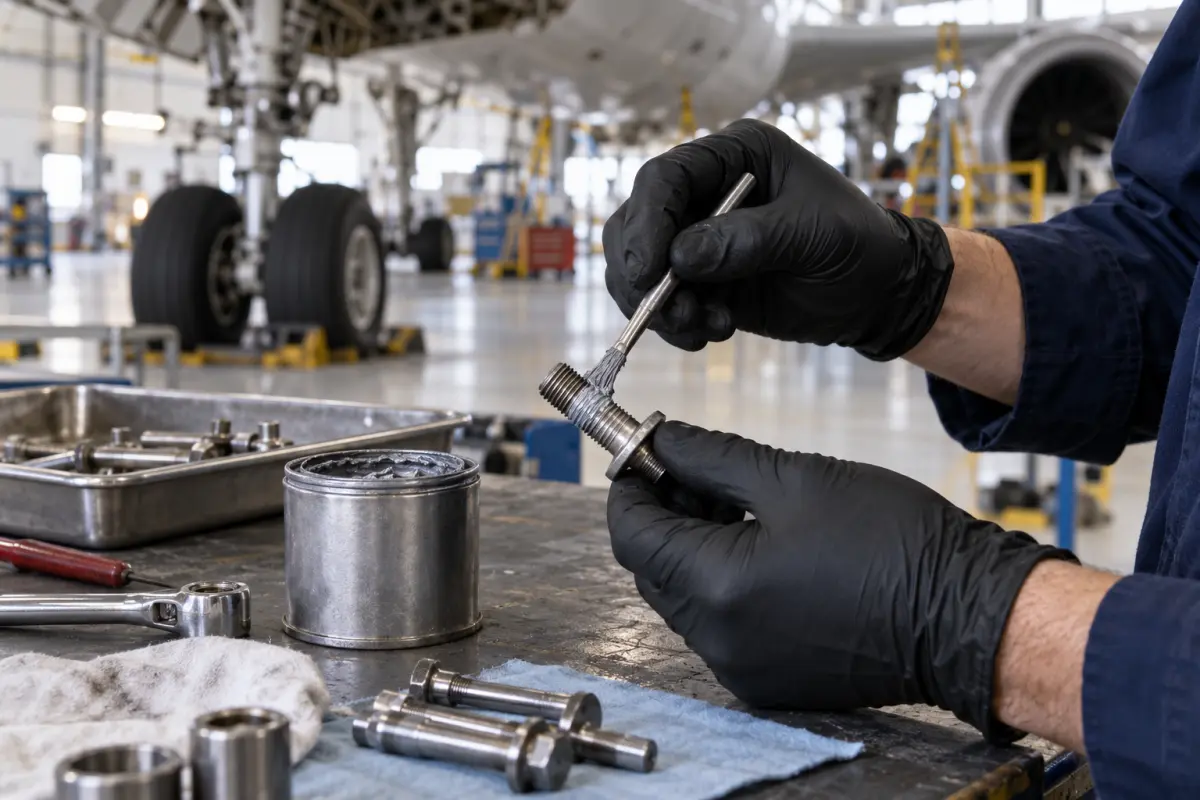
Anti Seize Compound Aviation: Selection Guide for MRO
An anti seize compound for aviation is a material applied to specified mating surfaces to help prevent galling, corrosion, or seizure and make later disassembly possible. For aircraft maintenance, the right choice depends on the exact application, fastener materials, product formulation, and maintenance instructions—not simply the highest advertised temperature range.
Key Takeaways
- Anti-seize is not interchangeable with a threadlocker or a general-purpose grease.
- Identify the required part number and application before comparing product descriptions.
- Nickel, solid-lubricant, paste, and spray formulations are distinct purchasing choices.
- Lubricated threads can produce a different clamp load at the same torque than dry threads.
- A useful RFQ states the part number, package requirement, quantity, and documentation needs.
What Anti-Seize Does in Aircraft Maintenance
Threaded fasteners and other contacting metal surfaces can become difficult to separate after exposure to heat, moisture, corrosion, or repeated assembly. Galling is a particular concern when mating surfaces adhere and tear as they move against one another. An anti-seize compound places a lubricating and separating material at the interface to reduce that risk.
The term describes a function, not one universal chemistry. Products sold for anti-seize work include compounds, pastes, lubricants, and sprays. Some are aimed primarily at threaded assembly; others also address slow-speed sliding or metal-to-metal lubrication. That distinction matters when a buyer receives a maintenance request that says only “anti-seize.” It does not identify the approved product, its form, or where it will be applied.
Anti-seize and threadlocker also serve different purposes. Anti-seize generally facilitates assembly and later separation; a threadlocker is selected to resist unintended loosening of a threaded joint. Neither should be treated as a substitute for the other. For a closer look at the latter, see CraftJetAero’s threadlocker selection guide for aviation.
How Product Types Differ
Product descriptions provide a starting point for narrowing an inquiry, but they do not establish interchangeability. The examples below show why a buyer should preserve the requested identifier rather than replacing it with a product that merely has a similar label.
| Product | Described type or formulation | Selection distinction |
|---|---|---|
| Bostik Never-Seez NSBT-8N | Pure-nickel, copper-free anti-seize compound | A defined formulation when a request specifically calls for nickel or excludes copper. |
| Rocol Anti Seize Stainless | Anti-seize paste described for nimonic, stainless, and silver-coated fasteners | A fastener-focused product whose stated material applications differ from a generic anti-seize request. |
| Castrol Braycote 868 | Molybdenum disulfide and silicone-oil anti-seize lubricant | Described for threaded parts and slow-speed sliding surfaces. |
| Rocol Anti-seize 797 | Anti-seize compound with stated low chlorine and sulfur levels | A distinct product identifier and formulation to evaluate against the specified application. |
Form is another practical difference. A paste or compound can be placed on an accessible surface during assembly, while a spray may be requested where its method of application is useful. That does not mean the forms can be swapped: their composition, placement, and resulting film may differ. Likewise, a lubricating paste that offers anti-seize protection is not automatically the same product as an anti-seize compound specified for a particular fastener.
What to Check Before Selecting a Compound
Begin with the maintenance task rather than the catalog category. A threaded connection, a slow-moving sliding interface, and a dissimilar-metal joint raise different questions. If an engineer has already identified an exact product, procurement should retain that identifier through the RFQ and review any proposed alternative separately.
- Location and function: Record the component, mating surfaces, and whether the material is intended for assembly, disassembly protection, or another stated purpose.
- Materials: Identify the fastener and mating-surface materials and any formulation restrictions, such as a request for a copper-free product.
- Service environment: Note expected exposure to heat, moisture, or other conditions relevant to the joint. A published temperature range alone does not determine suitability.
- Application form: Specify compound, paste, lubricant, or spray if the instruction or work package calls for one.
- Joint assembly requirements: Identify the applicable torque or installation instruction. Lubrication changes friction, so a dry-thread torque value should not be assumed to apply unchanged.
- Purchasing details: Capture the manufacturer, exact part number, required package size, quantity, and any requested lot or shelf-life documentation.
Keep the technical caution in one place: use only materials and application methods permitted by the applicable aircraft maintenance documentation and engineering approvals, and follow the product manufacturer’s current data sheet. Do not infer airworthiness approval, material compatibility, an installation torque, or permission to substitute from a supplier listing.
Turning a Maintenance Request into an RFQ
A clear request reduces the chance that a similarly named product will be quoted in place of the intended one. For example, a buyer could write: “Please quote Bostik Never-Seez, part number NSBT-8N, anti-seize compound; quantity and required package size: [insert requirements]. Please identify the manufacturer part number and available lot documentation in your response.” The bracketed details are fields for the buyer to complete, not product specifications.
If the work order says only “anti-seize for stainless fasteners,” ask the requesting engineer for the governing product identifier and installation reference before soliciting an alternative. The phrase describes a potential use but leaves open the formulation, application method, and purchasing unit. An RFQ should not turn that incomplete description into an assumed approval.
For comparisons, ask suppliers to identify the exact product offered rather than stating that it is “equivalent.” Engineering can then assess a proposed change against the maintenance requirement. This separation of purchasing and technical review is especially useful when a compound, a lubricating paste, and an anti-seize spray appear in the same search results.
Sourcing from CraftJetAero
CraftJetAero lists aviation chemicals, including anti-seize products. Buyers can request a quote from CraftJetAero by part number and include the required quantity, package size, and documentation requirements.
Frequently Asked Questions
What is an anti seize compound used for in aviation?
It is used at specified mating surfaces to help limit galling, corrosion, or seizure and support later disassembly. Its use on any particular aircraft joint depends on the applicable maintenance instructions.
Is anti-seize the same as threadlocker?
No. Anti-seize is generally used to reduce friction and sticking at an interface, while threadlocker is used to resist unintended loosening. They are not automatic substitutes.
Can I choose anti-seize by temperature rating alone?
No. Temperature is only one selection factor; formulation, contacting materials, application form, and the specified maintenance procedure also matter.
Does anti-seize change fastener torque?
It can change thread friction and therefore the clamp load produced at a given torque. Use the installation instructions applicable to the lubricated joint rather than assuming a dry-thread value still applies.
Are anti-seize paste and anti-seize spray interchangeable?
Not necessarily. They may differ in composition and how material is deposited on the surface, even when both are described as anti-seize products.
What should an MRO buyer include in an anti-seize RFQ?
Include the manufacturer and exact part number, quantity, package requirement, and any documentation requested by the maintenance team. If the product is not identified, obtain clarification before treating another product as an alternative.