
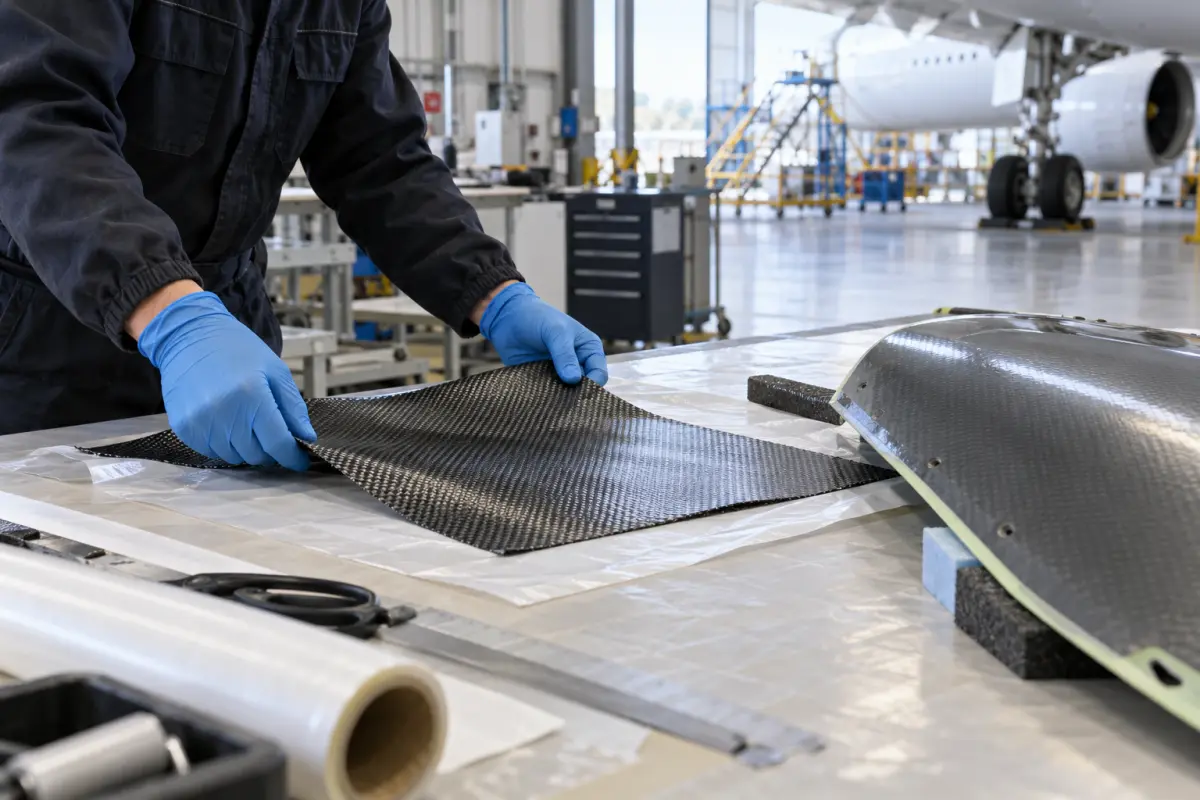
What Is Prepreg? Aircraft Composites and MRO Buying Guide
Prepreg, short for pre-impregnated reinforcement, is fiber fabric or another reinforcement supplied with resin already incorporated into it. In aircraft composites, it gives technicians a material with a defined fiber-and-resin combination for layup and curing, rather than requiring them to add resin to dry reinforcement during the job.
Key Takeaways
- Prepreg combines reinforcement and uncured or partially cured resin in one supplied material.
- Dry fabric requires a separate resin-application step; prepreg arrives with resin already incorporated.
- Fiber type, resin system, fabric construction, and material form all matter when identifying a prepreg.
- Storage and handling history can be as important to a purchase as the part number.
What Is Prepreg Made Of?
A prepreg has two essential parts: reinforcement, which provides much of the composite’s strength and stiffness, and a resin system, which binds the reinforcement together after cure. The reinforcement may be a woven fabric or another fiber form. Carbon fiber and glass fiber are common examples in aerospace composites; epoxy is a common resin type.
The word prepreg describes the material’s supplied condition, not a single fiber, resin, or finished component. Two rolls described as prepreg can differ substantially in reinforcement type, weave, resin chemistry, thickness, and intended application. For example, AIRPREG-PECF6550-T2F2 epoxy prepreg is described as an S2-glass fabric material for aircraft radome applications. That description does not make it interchangeable with a carbon-fiber prepreg intended for a different part.
During composite fabrication or repair, technicians place material in the required orientation and shape. The resin then cures under the specified process conditions, producing a consolidated composite. The resulting properties depend on the particular material and how it is processed—not on the term “prepreg” alone.
Prepreg vs. Dry Fabric: What Changes in the Shop?
The practical distinction is when and how resin is introduced. With dry reinforcement, resin is supplied separately and introduced during fabrication. With prepreg, the reinforcement is supplied with resin already incorporated. Both approaches can produce composite parts, but they call for different material orders and process plans.
| Consideration | Prepreg | Dry reinforcement |
|---|---|---|
| Condition when supplied | Reinforcement with resin incorporated | Reinforcement without an incorporated resin system |
| Resin procurement | Resin system is part of the prepreg selection | Compatible resin is procured and managed separately |
| Layup preparation | Material is cut and laid up as a resin-containing ply | Resin must be introduced through the selected fabrication method |
| Buyer’s key question | Which exact prepreg and handling condition are required? | Which fabric and separate resin system are required? |
A fabric family may be offered in more than one form. The listing for HEXFORCE G0806 7 1000 carbon fiber reinforcement, for instance, identifies dry and prepreg forms. A request that names only the fabric could therefore leave a material question unresolved. The buyer should state the required form and full ordering identifier.
Do not confuse prepreg with adhesive film. Prepreg supplies resin-bearing reinforcement for a composite laminate; an adhesive film is selected to bond surfaces. LOCTITE EA 7000 050NW AERO epoxy film adhesive is described for composite bonding applications, including co-curing with composite prepregs. Its role in that example is bonding, not serving as the fiber-reinforced ply.
Where Is Prepreg Used in Aircraft Work?
Prepreg is used to make composite laminates and may be specified for composite repair. Its suitability for a particular task depends on the engineered material system and the process defined for that part. Applications can involve different combinations of fiber, resin, and ply orientation; a radome material, for example, should not be treated as a generic substitute for another composite material simply because both are prepregs.
For MRO teams, the most useful question is often not “Do we need prepreg?” but “Which prepreg does this repair call for?” A repair package may distinguish a glass-fiber ply from a carbon-fiber ply, identify a particular resin system, and specify the material form. It may also call for a separate bonding material. These distinctions affect what procurement orders and what technicians receive at the worksite.
Prepreg also differs from a finished composite component. The roll or sheet is an input to a controlled layup and cure process; the cured article is the resulting part or repair. Buyers should keep those two stages distinct when searching catalogs or comparing supplier descriptions.
How Should Buyers Specify a Prepreg?
Start with the exact material identifier in the purchasing or repair documentation. Then make the requested form and accompanying documentation explicit. A generic description such as “carbon prepreg” may be useful for an initial search, but it does not identify a unique product.
- Identifier: Provide the complete manufacturer part number or other specified ordering reference, including suffixes.
- Material form: State prepreg rather than dry fabric, and identify the required fiber and construction if documented.
- Quantity and format: Specify the required quantity and any required roll, sheet, width, or cut format.
- Handling information: Ask for the applicable storage requirements and available lot, expiration, and handling records needed by your receiving process.
- Supporting documents: Identify the manufacturer documentation your quality or engineering team needs to review.
For example, a buyer could write: “Please quote AIRPREG-PECF6550-T2F2 epoxy prepreg, quantity as stated in the attached purchase request. Confirm the supplied material form and provide applicable storage guidance and available lot and expiration information for review.” This asks about the identified material without assuming that its name alone establishes every purchasing or receiving requirement.
Airworthiness caution: Before use, confirm the material and any substitution against the applicable aircraft maintenance documentation and required approvals; follow the manufacturer’s data sheet for storage, handling, and cure.
What Receiving Details Matter?
Prepreg purchasing does not end when a matching name appears on a quote. Because the material contains a resin system before use, receiving teams need enough information to assess whether its documented handling history meets their requirements. The relevant records and acceptance criteria depend on the specified material and the organization’s procedures.
Check the label and paperwork against the order: complete identifier, material form, quantity, lot information, and any required expiration or handling information. If an offer refers to a related fabric rather than the requested prepreg, resolve that difference before treating it as a match. Likewise, a listing that identifies a material only as “prepreg” may require further clarification of the manufacturer and product details.
Keep questions about equivalence separate from questions about availability. A supplier may be able to identify a candidate material, but an engineering determination is needed wherever the maintenance documentation does not already authorize the proposed choice.
Sourcing from CraftJetAero
Buyers can request a quote from CraftJetAero by part number. Include the required material form, quantity, and documentation needs in the request so the inquiry identifies the prepreg you are seeking.
Frequently Asked Questions
What does prepreg mean?
Prepreg means pre-impregnated reinforcement: fiber material supplied with resin already incorporated. It is an input to composite fabrication, not a finished cured component.
Is prepreg the same as carbon fiber?
No. Carbon fiber is a reinforcement, while prepreg describes reinforcement supplied with resin. Prepreg can use carbon fiber or another reinforcement, such as glass fiber.
Is dry carbon fiber fabric a prepreg?
No. Dry fabric does not have the prepreg’s incorporated resin system. Some reinforcement products are offered in both dry and prepreg forms, so buyers should specify which form they need.
Does every prepreg use the same cure process?
No. Cure requirements depend on the specific resin system and application. The word “prepreg” alone does not establish a cure temperature, time, or method.
What should an aircraft MRO buyer include in a prepreg inquiry?
Include the complete part number, required form and quantity, and the storage, lot, expiration, and documentation details your receiving process requires. State any format requirements rather than assuming they are evident from the product name.