
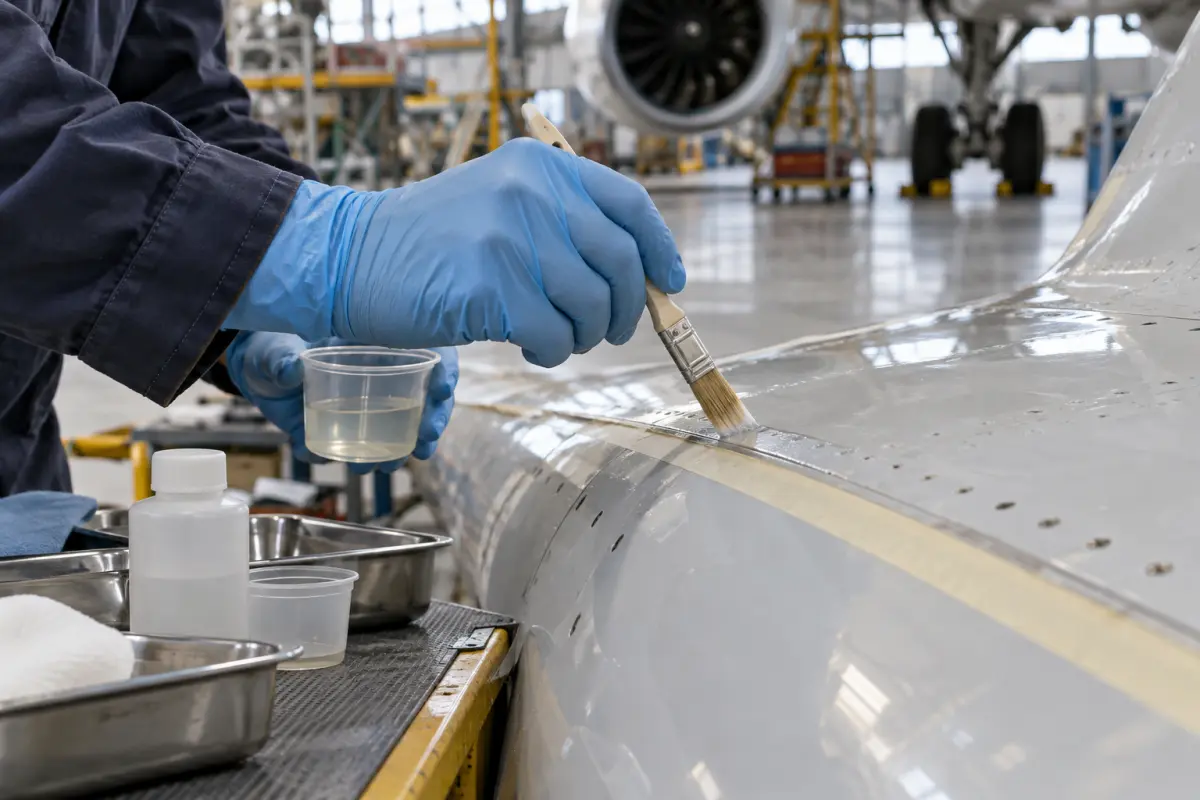
What Is an Adhesion Promoter? Aircraft MRO Buying Guide
What is an adhesion promoter? It is a surface-treatment material applied before a sealant, adhesive, coating, or tape to help that material bond to a specific substrate. In aircraft maintenance, the right promoter depends on both sides of the bond: the material being applied and the metal, paint, plastic, composite, or other surface beneath it.
Key Takeaways
- An adhesion promoter prepares an interface; it does not replace the sealant, adhesive, or tape.
- Match the product to the bonding material and substrate, not just the label “adhesion promoter.”
- Polysulfide sealant promoters, polyether promoters, silicone primers, and tape-edge promoters serve different applications.
- A useful purchase request identifies the part number, intended material, substrate, and required documentation.
How an Adhesion Promoter Works
A bond has two sides: the material being installed and the surface receiving it. An adhesion promoter is applied at that interface to help the two work together. Its purpose is to improve adhesion where the underlying surface or the bonding material would otherwise make a dependable bond difficult to achieve.
The term describes a function, not one universal chemical formula. A promoter intended for a polysulfide sealant should not be assumed suitable for a silicone elastomer, a polyether compound, or the edge of a protective tape. Product selection starts with the complete assembly: What will be applied? What will it touch? Where on the aircraft will the bond be used?
Adhesion also depends on surface condition. Contamination, residual cleaner, loose coating, or moisture can interfere with bonding even when the specified promoter is used. This is why maintenance instructions commonly treat surface preparation and promoter application as separate steps rather than asking the promoter to compensate for an unprepared surface.
Adhesion Promoter vs. Primer: What Is the Difference?
“Primer” and “adhesion promoter” can overlap in everyday usage. Both may be applied before another material to improve bonding. In procurement, however, the names are not interchangeable substitutes for a specified part number: a silicone primer and a polysulfide sealant promoter are intended for different material systems.
| Material type | Example from the supplied product listings | Selection question |
|---|---|---|
| Polysulfide adhesion promoter | PR-142 is described as promoting the coupling of polysulfide compounds on various substrates. | Is the installed material a polysulfide compound, and which substrate will it contact? |
| Polyether adhesion promoter | PR-187 is described as an adhesion promoter for polyether compounds on metals, composites, and plastics. | Is the specified compound polyether, and is the receiving surface covered? |
| Silicone primer | DAPCO 1-100 is described as a primer that enhances RTV silicone system bond strength. | Does the application call for a silicone-system primer rather than a sealant promoter? |
| Tape-edge adhesion promoter | The listed application procedure for 3M 8641/NP protective tape calls for 3M Adhesion Promoter 86A at key edges. | Does the tape installation procedure specify treatment at particular locations? |
A coating primer may also have purposes beyond adhesion, depending on the coating system. The practical distinction is therefore the specified use, not the word on the container. If an engineering instruction calls for a named silicone primer, ordering a product described only as an adhesion promoter does not establish equivalence. For related terminology, see CraftJetAero’s guide to aircraft primer types.
Where Aircraft Maintenance Teams Use Them
Sealant work is one common setting. The listed PR-142 adhesion promoter is a one-part product described for coupling polysulfide compounds to various substrates, with aircraft windshields identified as an application. Its product listing says it can be applied by brush or gauze. Those details help identify a candidate product, but they do not mean every windshield material or sealant system calls for PR-142.
Another polysulfide example is Naftoseal MC-115, listed as a one-component adhesion promoter for polysulfide sealants on metal and painted surfaces. In contrast, PR-187 is listed for polyether compounds and for use on metals, composites, and plastics. The different compound families are a reason to verify a request rather than grouping all three items under a generic “sealant promoter” description.
Silicone bonding is another distinct case. DAPCO 1-100 is listed as a silicone primer for RTV silicone systems, while other listed silicone primers address silicone elastomer adhesion or adhesion of RTV and heat-cure silicones to particular substrates. Protective tape presents a different use pattern again: the supplied 8641/NP description places adhesion promoter at key edges as part of a tape application procedure. These examples illustrate why the location and the material system matter as much as the broad product category.
A Practical Selection and Application Workflow
For an MRO request, first identify the work being performed: sealing, silicone bonding, or tape installation. Next, record the exact bonding material and the receiving surface, including whether the surface is bare, painted, or made from another material. Then check the applicable instructions for the named promoter or primer and for any required surface-preparation and application steps.
- Identify the installed material. “Sealant” alone is less useful than “polysulfide sealant” or “polyether compound” when screening the listed examples.
- Identify every contact surface. A joint may involve more than one substrate, and a painted surface is not the same description as bare metal.
- Confirm the application location. A promoter called for at tape edges is not necessarily intended for the entire tape footprint.
- Match the named item. Keep the manufacturer and exact part number in the request; ask for clarification before treating another item as an alternative.
- Record documentation needs. Tell the supplier which product information and shipment documents your receiving process requires.
For example, a buyer could write: “Please quote PR-187 for a specified polyether-compound bonding task on a painted composite panel. Confirm the exact manufacturer part number and identify the product documentation available with the quote.” That wording gives the supplier more to check than “quote adhesion promoter,” without asking the supplier to determine the aircraft’s approved maintenance procedure.
Maintenance caution: Use the aircraft maintenance documentation and the manufacturer’s current product data sheet to verify the approved material, compatible substrates, surface preparation, application method, and any waiting or handling requirements. A product listing or quote does not establish airworthiness approval or authorize a substitution.
What to Include in a Purchase Request
The fastest way to avoid an ambiguous request is to lead with the exact part number when it is known. Add the manufacturer or brand shown in the maintenance records, the bonding material, the substrate, and the intended task. If the part number is not known, describe the application as a selection question rather than assigning a product based only on its category name.
For instance, “adhesion promoter for a polysulfide sealant on a painted surface” identifies a material family and substrate, but it still does not identify an approved part number. “Silicone primer for RTV silicone” points to a different product family. Procurement teams can use those descriptions to narrow a conversation with engineering; they should not use them as evidence that two products are interchangeable.
It also helps to distinguish packaging and documentation questions from technical suitability. A requester may need a specific unit of issue or documents for receiving and traceability. Those details belong in the inquiry alongside the part number so the response addresses what the buyer actually needs, while the maintenance team retains responsibility for the specified application.
Sourcing from CraftJetAero
Buyers can request a quote from CraftJetAero by part number. Include the product name, intended material and substrate, and any documentation requirements so the request can be reviewed against the item sought.
Frequently Asked Questions
Is an adhesion promoter the same as an adhesive?
No. An adhesive is the bonding material used to join surfaces; an adhesion promoter is a treatment used to help another material bond to a surface. It does not replace the specified adhesive or sealant.
Can one adhesion promoter be used with any aircraft sealant?
No. The supplied product descriptions distinguish promoters for polysulfide compounds from one for polyether compounds. Confirm the specified product against the particular sealant system and substrate.
Is a silicone primer an adhesion promoter?
A silicone primer can perform an adhesion-promoting function, but its name does not make it interchangeable with a promoter specified for another material family. Specify the exact product called for in the application.
Does adhesion promoter replace surface cleaning?
No. Surface preparation and promoter application are separate parts of a bonding procedure. Applying a promoter over contamination does not make the surface properly prepared.
What information should I provide when requesting a quote?
Provide the exact part number and manufacturer when known, plus the intended bonding material, substrate, and documentation requirements. If the part number is uncertain, flag that uncertainty rather than assuming a substitute.