
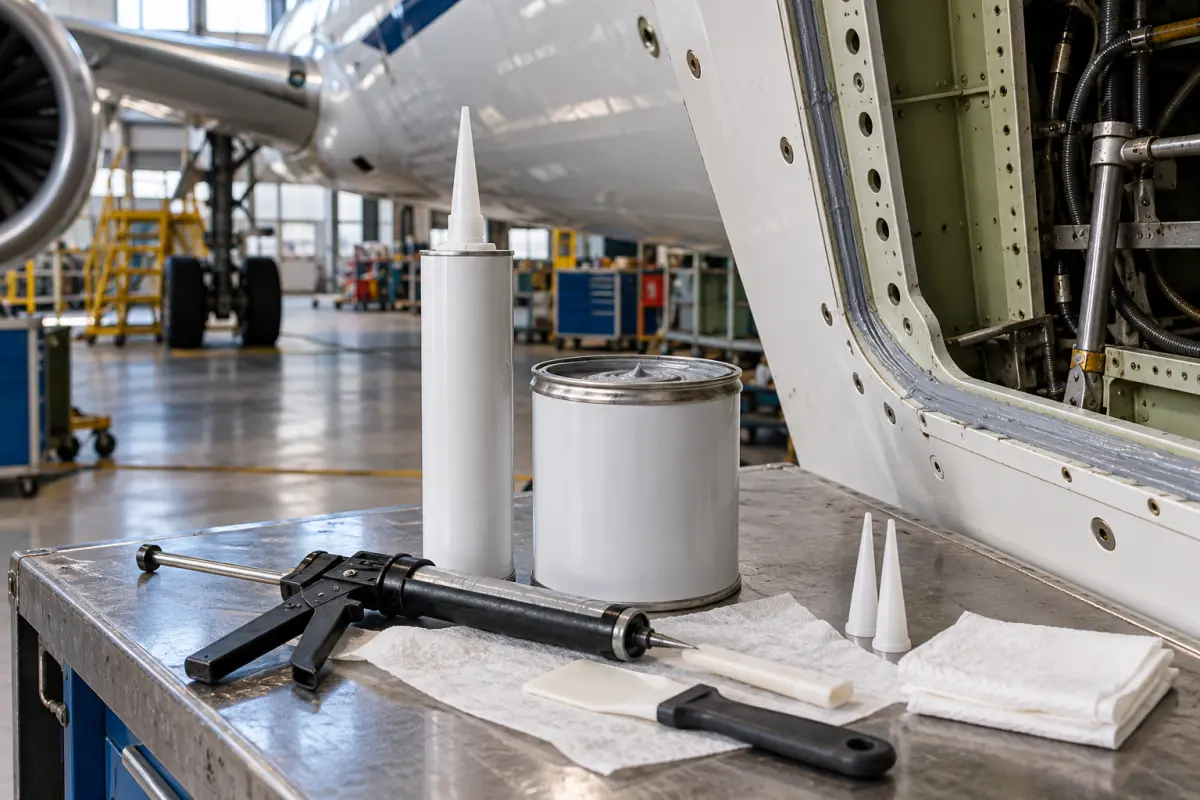
Polysulfide vs Silicone Sealant Aircraft Uses Explained
In the polysulfide vs silicone sealant aircraft comparison, the first question is what the seal must withstand. Polysulfide sealants are commonly specified for fuel-exposed aircraft joints and tanks, while silicone sealants are used for applications such as gasketing, electrical insulation and selected seals. Neither chemistry is a universal substitute for the other: the required application and specified product determine the choice.
Key Takeaways
- Start with the aircraft location and exposure conditions, not the sealant’s chemistry alone.
- Polysulfide products in this comparison include sealants intended for fuel tanks and fuselage joints.
- Silicone products in this comparison include sealants used for gasketing and electrical insulation.
- Part number, product form and application details make a sealant request more precise.
Where Each Sealant Family Fits
Polysulfide and silicone describe different sealant chemistries, but a chemistry name does not identify a complete aircraft maintenance material. Products within either family can differ in intended use, component count, application characteristics and compatible surfaces. For a buyer, “aircraft sealant” is therefore a starting category, not a sufficient purchasing description.
Fuel exposure is a useful initial distinction. The two-part polysulfide PPG PR1440A-1/2 sealant is described for integral fuel tanks, fuselage joints and fillets, with resistance to aviation fuels, hydraulic fluids and oils. NAFTOSEAL-MC650B-1 is another two-component polysulfide product described for fuselage seals and resistance to aviation gasoline and jet fuel. Those examples show why polysulfide appears frequently in fuel-related aircraft sealing requests; they do not mean every polysulfide product is interchangeable in those locations.
Silicone addresses a different set of common requests. Momentive RTV106 is described for high-temperature sealing, gasketing and electrical insulation. Silicone is not one fixed product form, however: DAPCO-18-4F is a two-component, solvent-free silicone paste described for use as a coating, sealant or filleting material. A request for “silicone” alone would not distinguish between those products or their intended jobs.
Polysulfide vs Silicone: Comparison at a Glance
The table compares selection questions rather than assigning every property of one product to an entire chemistry. It is most useful when the maintenance request has not yet been narrowed to a part number.
| Selection question | Polysulfide sealant | Silicone sealant |
|---|---|---|
| What applications appear in the supplied product descriptions? | Integral fuel tanks, fuselage seals, joints, fillets and access-door joints | Gasketing, electrical insulation, sealing, coating and filleting |
| Is fuel exposure part of the stated use? | Several listed products are specifically described as resistant to aviation fuel. | The listed silicone descriptions do not establish a general fuel-tank application. |
| Does the chemistry identify the mixing format? | No. Confirm the format for the exact part number; the polysulfide examples here are two-component products. | No. The examples include an RTV silicone sealant and a two-component silicone paste. |
| What should procurement identify? | Exact part number, sealing location, required quantity and any specified packaging | Exact part number, intended use, required quantity and any specified packaging or primer |
One distinction deserves particular attention: “silicone” does not mean “electrical sealant only,” and “polysulfide” does not mean “fuel tank only.” The listed silicone paste has coating and filleting uses, while the listed polysulfides include products for fuselage and access-door joints. The product description and the specific maintenance task provide more useful detail than a family label.
How to Narrow a Maintenance Request
Begin by locating the seal in the aircraft and describing its function. Is the request for an integral fuel tank, a fuselage joint, an access door, a gasket or an electrically insulating seal? A physical location helps distinguish a sealing task from a superficially similar one elsewhere on the aircraft.
- Record exposure. Note whether the seal is expected to encounter aviation fuel, hydraulic fluid, oil or another relevant service environment.
- Identify the specified product. Capture the complete manufacturer and part number, including punctuation and suffixes. Small differences in a part-number string can identify different items.
- Confirm the form needed. State whether the request calls for a two-component material, a paste or another specified form. Do not infer form solely from “polysulfide” or “silicone.”
- Capture the application details. Include the aircraft location, required quantity, packaging requirement if specified, and any associated primer identified in the job requirements.
For example, “Need aircraft sealant for a fuel-tank joint” leaves the buyer to identify the actual material. “Please quote PPG PR1440A-1/2 for a specified fuel-tank sealing task; advise on the requested package configuration and quantity” gives the supplier a usable identifier while keeping the application context visible. A silicone request should be equally specific: name RTV106 if that is the required part rather than asking for a generic high-temperature RTV.
Product Form, Primers and Substitution
Component count matters to planning and identification. PR1440A-1/2 and NAFTOSEAL-MC650B-1 are described as two-component polysulfide products, while DAPCO-18-4F is a two-component silicone paste. The fact that two materials both have two components does not make their chemistries or uses equivalent. Likewise, two sealants sold under the silicone family can serve different maintenance tasks.
Substrate preparation may also involve a separate material. DOWSIL-1200-OS/CLEAR primer is described for improving adhesion development of room-temperature-vulcanizing silicone sealants to various common nonporous substrates. Its presence in a purchasing list should not be taken to mean that every silicone sealant application requires that primer; the specified sealant, substrate and procedure determine whether it belongs in the request.
Maintenance caution: Use only materials and substitutions permitted by the applicable aircraft maintenance documentation and required approvals; follow the sealant manufacturer’s data sheet and the maintenance procedure for preparation, application and return-to-service decisions. Purchasing a material from the same chemistry family does not, by itself, establish airworthiness or interchangeability.
What Buyers Should Put on the Quote Request
A concise request can prevent an avoidable round of clarification. Lead with the exact part number, then add the manufacturer, requested quantity and package configuration if known. If the part number is still being identified, describe the aircraft location and exposure conditions without presenting a candidate sealant as an approved replacement.
Keep related materials distinct on the request. A primer is a separate line item from a sealant, and a two-component silicone paste should not be grouped with an RTV sealant merely because both are silicone products. Separating those entries helps the engineering and purchasing teams compare the requested items against the job requirements.
Sourcing from CraftJetAero
CraftJetAero buyers can request a quote by part number. Include the exact sealant identifier and quantity, along with any specified package configuration or separate primer requirement, so the request identifies the material needed.
Frequently Asked Questions
Is polysulfide or silicone better for an aircraft fuel tank?
Several polysulfide products described here are intended for fuel-related sealing, including PR1440A-1/2 for integral fuel tanks. The correct material for a particular tank task is the one specified for that application, not a chemistry chosen in isolation.
Can silicone sealant replace polysulfide sealant on an aircraft?
Not on the basis of chemistry or appearance alone. A proposed replacement must be evaluated against the specified application and maintenance requirements.
Are all silicone aircraft sealants single-component RTV products?
No. RTV106 is a silicone sealant, while DAPCO-18-4F is described as a two-component silicone paste. Identify the exact product rather than assuming its format from the chemistry.
Does every silicone sealing job need a primer?
No universal primer requirement follows from the word “silicone.” Some procedures may specify a separate primer; others may not.
What information helps a supplier identify the right sealant?
Provide the complete part number and manufacturer when known, plus the quantity and required package configuration. If identification is still in progress, include the sealing location and relevant exposure conditions for clarification.