
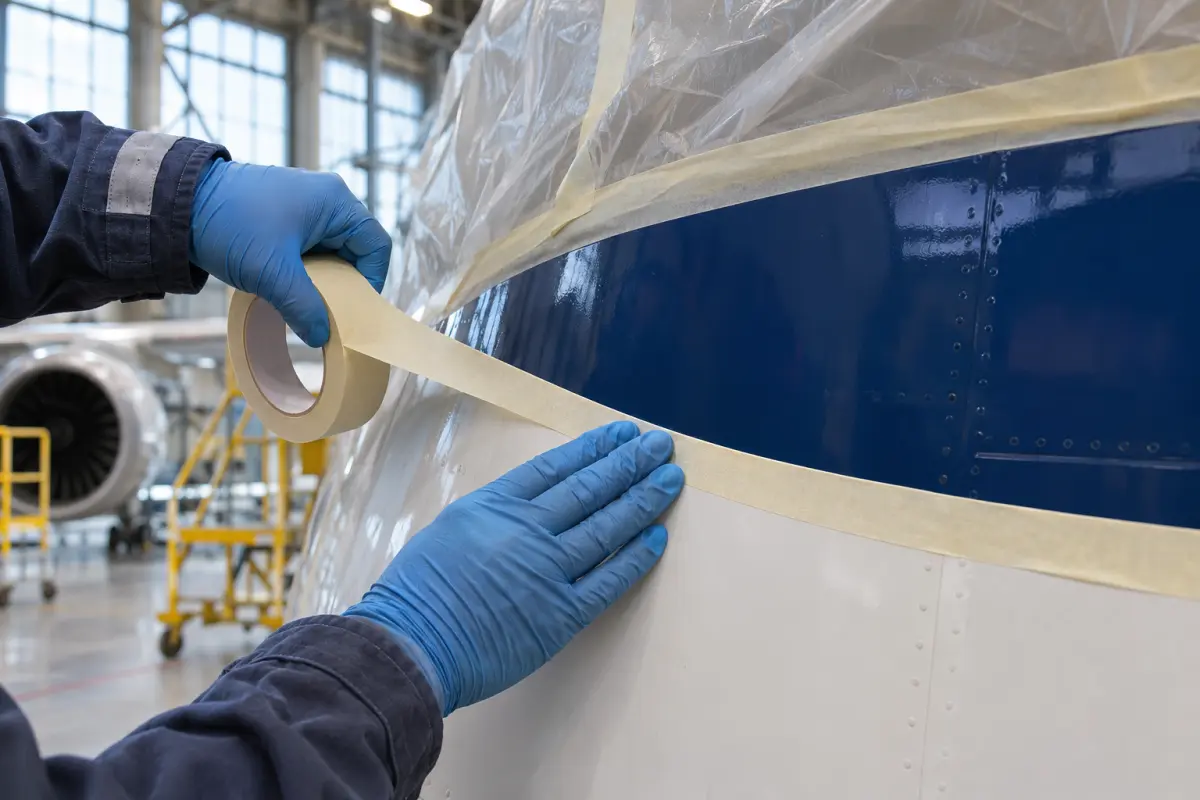
Masking Tape for Aircraft Painting: Selection and Buying Guide
Masking tape for aircraft painting temporarily protects surfaces and defines paint boundaries during preparation, spraying, and finishing. The right tape depends on the surface being masked, the shape of the paint edge, exposure to process heat, and how cleanly the tape must remove. Buyers should identify the exact product and roll configuration rather than treating all masking tapes as interchangeable.
Key Takeaways
- Match the tape to the substrate, paint-edge geometry, and planned process temperature.
- A temperature figure is meaningful only with its stated exposure time and test context.
- Conformable crepe tape can follow curves; straight edges and intricate contours call for different masking plans.
- Include the manufacturer, part number, roll width, quantity, and intended use in a quote request.
What Aircraft Paint Masking Tape Needs to Do
Masking tape creates a temporary boundary between an area receiving coating and an area that must remain uncovered. On an aircraft, that may mean defining a color break on an exterior panel, protecting an adjacent component during a small repair, or holding masking paper or film in place. These jobs place different demands on the tape: a visible color break emphasizes edge placement, while a broad protected area may require more attention to keeping the covering secure.
Three construction features matter when comparing products. The backing influences how the tape follows a curve or tears during application. The adhesive influences initial hold and removal behavior. Roll width affects whether a technician can place the tape accurately at the edge or cover an adjacent area efficiently. A wide roll is not automatically a better choice for a narrow stripe or a tight radius.
Also distinguish a product's stated uses from the needs of a particular paint operation. A tape described for holding, bundling, and masking may be useful in a shop without being the preferred choice for every exposed paint edge. Likewise, a general-purpose painting tape and a tape described for precision masking can serve different roles in the same job.
Compare Masking Tapes by the Job
The products below illustrate how buyers can narrow a request using published product descriptions. Where a temperature and duration are listed, they describe the cited product's stated condition—not a general rating for all masking tapes or an instruction to use that product in every heated paint process.
| Product | Described construction or use | Useful buying distinction |
|---|---|---|
| 3M Crepe Masking Tape 202 | Painting tape described as adhering to metal, rubber, glass, and plastic; tested to remove cleanly at 250°F (121°C) for 30 minutes. | Ask about it when the masking plan involves more than one listed surface or a defined heat-exposure requirement. |
| 3M General Purpose Masking Tape 234 | Described for painting, paint-bake operations, and bundling; stated to withstand up to 250°F (121°C) for 30 minutes. | Separate the planned bake temperature and duration from the broader description of the job. |
| Tesa 4323 | Conformable crepe paper with natural rubber adhesive; described for masking, sealing, and light painting tasks. | Consider the described conformability when the work includes curved boundaries. |
| 3M Value Masking Tape 101E | Crepe paper backing and rubber-based adhesive; described for holding, bundling, sealing, and masking, with a stated limit of 60°C for 30 minutes. | Identify whether the request is for general shop masking or a paint step with a specified heat exposure. |
| Bron Aerotech BA-6866 | Natural rubber adhesive; described for precision masking on plastic parts and multi-color finishes. | Ask about this exact part number when a plastic-part color boundary is the purchasing need. |
Temperature descriptions are not directly equivalent when they report different conditions or omit a duration. For example, the stated 30-minute conditions for 202, 234, and 101E allow a buyer to frame a more specific question; they do not establish that those tapes will behave identically on a given painted surface. For BA-6866, the supplied description mentions high-temperature resistance but gives no numerical limit, so a buyer should not assign one.
Build the Masking Plan Before Choosing a Roll
Start with the boundary the technician must create. A long, relatively straight paint line is a different placement task from a curved color transition around a fairing. Crepe-paper backings can conform to modest contours, but the shape and visibility of the finished edge still determine how carefully the first strip must be placed. Wider tape can then extend the protected area or help secure masking material behind that edge.
- Identify the surface: Record whether the tape will contact painted metal, bare metal, plastic, glass, rubber, or a combination. A tape that holds on one surface may not be the intended choice for another.
- Describe the edge: Note whether the job calls for a straight boundary, a curve, a multi-color break, or temporary protection without a visible finish line.
- Record the process: Specify whether the taped area will see ambient painting only or a heated step, and state the planned temperature and exposure duration if applicable.
- Choose the configuration: Request the roll width needed for edge placement and coverage. A buyer can ask for more than one width when the edge strip and the surrounding masking serve different purposes.
- Define removal needs: State whether the tape contacts a sensitive existing finish or another surface where residue or surface marking would complicate cleanup.
A practical plan might use a narrow strip to define a curved color break on a plastic part and a wider strip to help hold protective masking away from the edge. That does not mean both strips must be the same product: the edge-making task and the material-holding task can be evaluated separately.
For aircraft work, use only materials and processes permitted by the applicable aircraft maintenance documentation and required approvals. Follow the tape manufacturer's data sheet for surface suitability, application, heat exposure, and removal, and verify compatibility with the coating process before use.
Write an RFQ That Prevents Product Mix-Ups
A useful request for quotation gives the supplier enough information to identify the requested tape without guessing. Lead with the manufacturer's name and exact part number, then provide the required roll width, order quantity, and any packaging or identification requirements. Describe the intended task so a difference between an edge-masking product and a general holding tape is visible before purchasing.
For example: “Please quote Bron Aerotech BA-6866 masking tape for a multi-color paint boundary on a plastic aircraft part. Specify the available roll width and identify the manufacturer and part number on your quotation. Quantity required: [insert quantity].” The bracketed quantity is a field for the buyer to complete, not a product specification.
Be precise when a catalog presents more than one listing for a part number. The supplied product information includes multiple listings for TESA-4323 and for 3M-101E, with different roll descriptions or application details. Repeating the part number alone may not communicate the desired width. Add the roll configuration to the request and compare the quoted item against the purchase requirement.
If a team is deciding between products, describe the difference as a decision to be resolved rather than asking for a generic equivalent. For instance: “The job involves a visible curved paint edge on plastic; quote the requested part number and note any proposed alternative separately.” That wording keeps the requested item identifiable and gives engineering or purchasing a clear basis for reviewing any alternate offer.
Sourcing from CraftJetAero
CraftJetAero buyers can request a quote by part number. Include the manufacturer, exact part number, required roll width, quantity, and a brief description of the aircraft painting task so the request identifies the intended product and configuration.
Frequently Asked Questions
What is masking tape for aircraft painting used for?
It temporarily protects adjacent surfaces and defines boundaries where coatings should stop. It can also help hold masking paper or film during painting preparation.
Is all aircraft masking tape suitable for a paint-bake step?
No. Product descriptions differ: 3M 234 is described for paint-bake operations, while other tapes may be described primarily for light painting, holding, or general masking. Compare the stated temperature and exposure duration with the planned process.
Why does roll width matter?
Width affects placement and coverage. A narrower strip can be easier to position along a detailed boundary, while a wider strip can protect more adjacent area or help secure masking material.
Can a buyer specify only the masking tape part number?
A part number is the starting point, but the roll width and quantity make the request clearer. These details are especially helpful when more than one catalog listing uses the same part number.
How do I compare 3M 202 with 3M 234?
Both supplied descriptions mention a 250°F (121°C), 30-minute condition. The 202 description emphasizes painting and adhesion to several surface types, while the 234 description explicitly mentions painting and paint-bake operations; select against the actual masking task rather than the temperature figure alone.