Aircraft Paint Remover: Selection Guide for MRO Buyers
An aircraft paint remover is a chemical product used to break down or lift an existing coating so it can be removed before inspection, repair, or repainting. For MRO procurement, the right choice depends on the coating being removed, the underlying surface, the work area, and the approved maintenance process—not simply whether a product is labeled a remover or a stripper.
Key Takeaways
- “Paint remover” and “paint stripper” describe overlapping product categories; compare products by coating and substrate requirements.
- Epoxy and polyurethane coatings are identified applications for ARDROX-2526, SOCOSTRIP-A0103N, and D23V.
- A useful quote request includes the exact part number, coating type, substrate, package requirement, and documentation needs.
- Plan for residue removal and the next surface-preparation step, not just coating removal.
What Does an Aircraft Paint Remover Do?
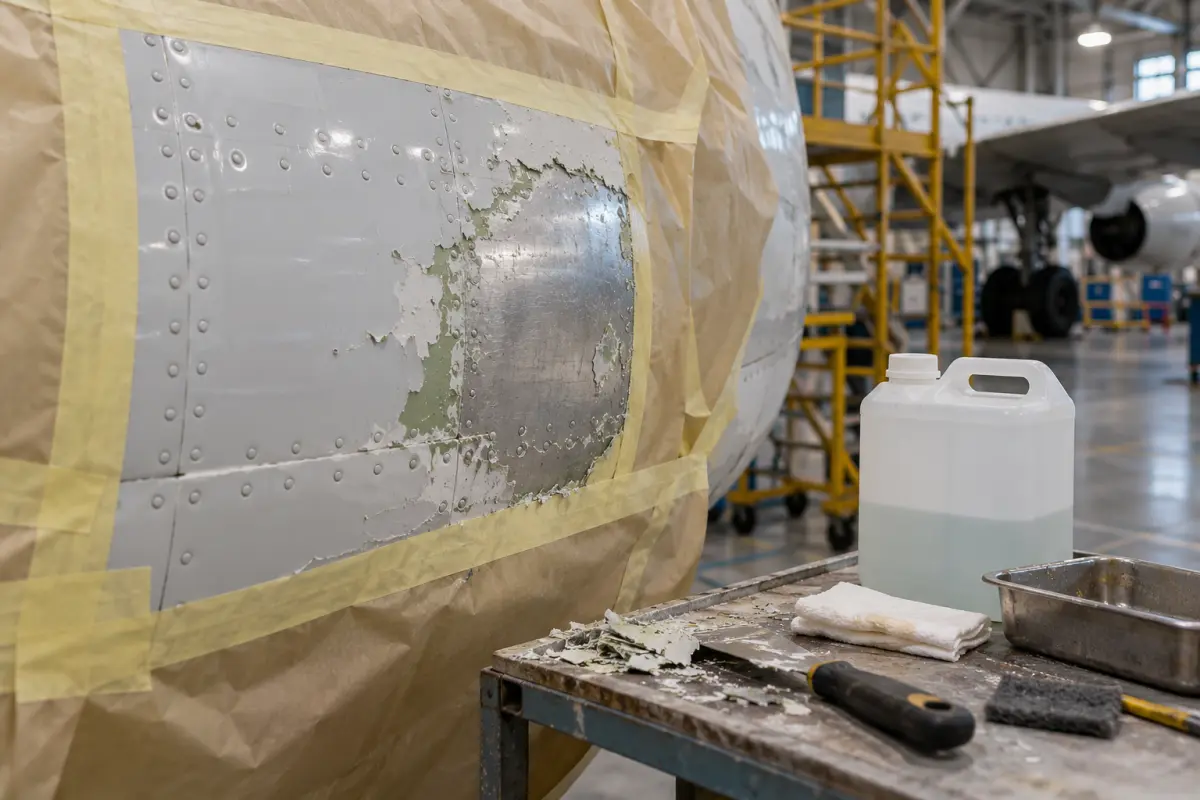
Aircraft paint removal may be needed when a coating has deteriorated, a repair requires access to the underlying surface, or an area must be prepared for a new coating system. A chemical remover acts on the coating so technicians can separate it from the surface using the specified process. That task differs from routine cleaning: removing soil or grease does not necessarily remove a cured finish.
The terms paint remover and paint stripper are often used interchangeably in product descriptions. Neither term, by itself, establishes that a product is appropriate for every coating or aircraft material. Buyers should identify what is on the aircraft now—such as an epoxy or polyurethane coating—and what surface lies beneath it. A product selected for one painted metal area should not automatically be assumed suitable for every adjacent material or component.
Removal is also only one stage of a larger job. The team may need to expose a surface for examination, remove remaining residue, and prepare it for the next treatment. If repainting is planned, coordinate the removal purchase with the specified primer and topcoat process; this aircraft topcoat paint selection guide explains the different roles of common topcoat types.
How Do the Listed Products Compare?
The three products below are identified in their listings for removing aircraft coatings, but their descriptions emphasize different characteristics. These are purchasing comparison points, not a ranking of removal speed or suitability for a particular aircraft.
| Part number | Listed product type and coating applications | Distinguishing details in the listing |
|---|---|---|
| ARDROX-2526 | Paint remover for challenging polyurethane and epoxy coatings | Described as non-flammable and formulated with chlorinated solvents and phenolic materials; the listing includes aircraft skins among its applications. |
| SOCOSTRIP-A0103N | Aircraft paint stripper for epoxy, polyurethane, and alkydurethane paints | The listing highlights controlled evaporation and application to metals. |
| D23V | Paint stripper for chemical-resistant epoxy and polyurethane paint on aircraft surfaces | Described as formulated for metals, with extended stripping activity and easy rinsing; the listing identifies a 25-liter drum. |
A coating match narrows the search, but it does not make two products interchangeable. For example, a request involving alkydurethane paint points a buyer toward the SOCOSTRIP-A0103N listing for further evaluation because that coating type is named there. For an epoxy or polyurethane removal job, all three listings warrant review; the final choice still depends on the specified surface, process, and product documentation.
Which Details Determine Product Fit?
Start with the coating rather than a broad request for “aircraft stripper.” Epoxy and polyurethane appear across all three listings, while alkydurethane is expressly named for SOCOSTRIP-A0103N. If the existing coating is unknown, obtain its identity from maintenance records or the engineering team instead of treating appearance as a reliable identifier. Multiple coating layers can also complicate a request: state whether the job concerns one known finish or a complete coating removal process.
Next, define the surface and boundaries of the work. “Aircraft skin” is more informative than “aircraft,” but a request is stronger when it identifies the specific work area and substrate. Note whether the treatment area includes joints, edges, fasteners, or neighboring materials that must be protected. This helps the technical team evaluate the entire work zone rather than only the main painted panel.
Finally, distinguish product characteristics from process requirements. A description such as “controlled evaporation” or “easy rinsing” can help identify a product worth reviewing, but it does not specify the application method, dwell period, removal technique, or cleanup instructions for a particular job. Ask for the current product data and safety documentation needed by the maintenance team, and state any packaging constraint in the request.
How Should Removal Fit Into the Maintenance Plan?
Before purchasing, clarify what successful removal means for the task. A team stripping a localized repair area may prioritize precise work boundaries, while a team addressing a larger painted surface may need to plan product quantity, access, and waste handling differently. The procurement description should reflect that distinction so the quoted item can be checked against the intended use.
- Identify the existing coating. Record the known coating family and whether more than one layer is involved.
- Describe the work area. Name the substrate and the limits of the area to be treated, including adjacent features of concern.
- Define the next operation. State whether removal supports inspection, repair, surface preparation, or repainting.
- Confirm purchasing details. Specify the requested part number and package requirement, and ask for the documentation your team needs to review.
Use only products and procedures permitted by the applicable aircraft maintenance documentation and required approvals; confirm that the work preserves airworthiness. Follow the manufacturer’s current product data sheet and safety instructions for surface compatibility, application, removal, and handling rather than relying on a brief catalog description.
What Should an MRO Buyer Put in a Quote Request?
An exact part number prevents an ambiguous inquiry from turning into a comparison of unlike products. Pair it with enough application context for an internal engineering or maintenance review. If a product has not yet been selected, ask the technical team to identify an acceptable part number or define the constraints before issuing a purchase request.
For example: “Please quote part number D23V for a planned epoxy and polyurethane coating-removal job on an aircraft metal surface. The product listing identifies a 25-liter drum; please confirm the quoted package and provide the current product documentation for our maintenance review.” This wording identifies the requested item and intended task without assuming that a catalog listing authorizes its use on a specific aircraft.
If comparing alternatives, keep the same job description in each inquiry. Ask for the exact manufacturer and part number on every response, rather than treating “aircraft paint remover” as a complete product identifier. That makes it easier to compare the offered items against the maintenance requirement and to avoid confusion between similarly described removers and strippers.
Sourcing from CraftJetAero
Buyers can request a quote from CraftJetAero by part number. Include the coating and substrate details, intended work area, package requirement, and documentation request when you contact CraftJetAero for a quote.
Frequently Asked Questions
Is an aircraft paint remover different from a paint stripper?
The terms overlap in product listings. Evaluate the named coating applications, substrate considerations, and specified removal process rather than choosing by the label alone.
Which listed products address epoxy and polyurethane paint?
ARDROX-2526, SOCOSTRIP-A0103N, and D23V all list epoxy and polyurethane coatings among their applications. Their other listed characteristics differ, so a coating match is only the first selection step.
Which listed stripper mentions alkydurethane paint?
SOCOSTRIP-A0103N lists alkydurethane as well as epoxy and polyurethane paints. The listing does not, on its own, establish suitability for a particular aircraft or work area.
Does non-flammable mean a remover needs no special handling?
No. ARDROX-2526 is described as non-flammable, but that description does not replace the product’s safety and handling instructions or the worksite’s controls.
What information helps prevent an incorrect quote?
Provide the exact part number, known coating type, substrate, work area, package requirement, and documentation needs. If any of those details are unknown, identify the gap so it can be resolved during technical review.