
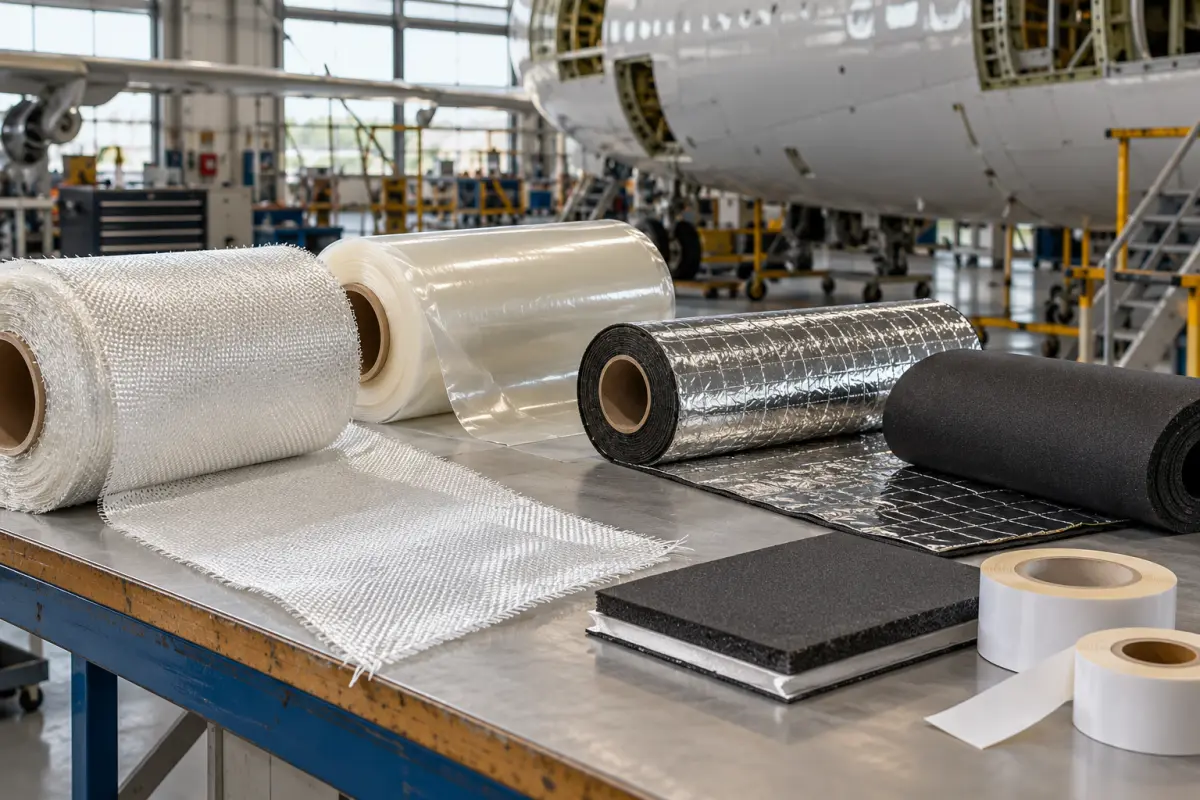
Aerospace Tapes Types: Uses and Selection Guide for MRO
Aerospace tapes types are best distinguished by what each tape is built to do: seal or patch, protect a surface, damp vibration, provide insulation, or bond materials. Glass cloth, polyurethane, foil-based damping, foam, silicone elastomer, and double-sided adhesive tapes are different product families—not interchangeable descriptions of the same material. For MRO procurement, the starting point is the specified part number and application, followed by the required dimensions and documentation.
Key Takeaways
- Choose an aerospace tape by its intended function, not by the word “aerospace” on a listing.
- Backing material and adhesive system both affect where a tape can be used.
- A protective polyurethane tape and a vibration-damping foil tape solve different problems.
- A purchase request should identify the exact part number, roll dimensions, quantity, and documentation requirements.
Common Aerospace Tape Types and Their Uses
Tape categories describe a construction, an application, or both. A glass cloth tape is named for its backing; a vibration-damping tape is named for its primary function. That distinction matters when comparing catalog entries: two products may both be called adhesive tapes while having different backings and intended uses.
| Tape type | Typical role | Example from the supplied product listings |
|---|---|---|
| Glass cloth | Sealing, splicing, or patching where a cloth-backed tape is specified | 3M 398FR, described for insulation blankets, panels, and ducts |
| Vibration damping | Reducing vibration and associated noise | 3M 436, an aluminum foil tape with a pressure-sensitive viscoelastic polymer |
| Polyurethane protective | Protecting exposed aircraft surfaces from physical damage | 3M 8673DL, a polyurethane elastomer protective tape |
| Silicone elastomer | Protection where a silicone elastomer tape is called for | ABS5334A01T, listed as a silicone elastomer tape |
| Foam | Insulation, sealing, or vibration dampening, depending on construction | A listed closed-cell vinyl/nitrile foam tape |
| Double-sided adhesive | Attaching compatible materials without an exposed outer tape face | RELINK-2318-B, described for interior paneling, trim, and insulation |
| Electrical insulating | Insulating electrical connections | P422, described for high-voltage coils and power cables |
The table is a way to narrow a search, not a substitution chart. An application such as insulation-blanket repair may involve a sealing tape, while attaching an insulation material to a panel may call for a double-sided adhesive. The shared word “insulation” does not make those products equivalent.
How Backing and Adhesive Change the Job
The backing is the visible body of a tape. It may contribute conformability, physical protection, or the surface characteristics needed for a particular task. The adhesive—or another bonding mechanism—is what holds the construction in place. A useful product comparison therefore asks two separate questions: what is the backing meant to do, and how is the tape meant to attach to the substrate?
For example, 3M 398FR glass cloth tape is described for flame-retardant sealing, splicing, and patching around insulation blankets, panels, and ducts. By contrast, 3M 8673DL polyurethane protective tape is presented as a surface-protection product for areas such as fuselages and wings. Selecting between them begins with the task: patch an identified material, or protect an exposed surface.
Adhesive construction also helps explain why tapes that look similar in a roll can serve different purposes. 3M 436 vibration damping tape combines aluminum foil with a pressure-sensitive viscoelastic polymer designed to absorb and dissipate vibration. Its defining purpose is not simply to cover a surface. A double-sided tape such as RELINK-2318-B instead places adhesive between materials; its listing describes use on textured plastics and textiles in aircraft interiors.
Match the Tape to the Substrate and Location
Once the function is clear, identify what the tape will touch. A buyer may hear “panel” and assume an exterior aircraft panel, while the requester means an interior trim panel. Those are different procurement contexts. Record the substrate and whether the tape will be used on an exposed surface, within an interior assembly, around insulation, or at an electrical connection.
- Insulation blankets and ducts: Ask whether the job is sealing a joint, splicing material, or patching damage. The required operation is more useful than a generic request for “insulation tape.”
- Exterior surfaces: Distinguish a protective film-like tape from a sealing or bonding tape. Note the aircraft area and the protection sought.
- Interior materials: Identify both materials being joined, such as a panel and a textile, when requesting a double-sided adhesive tape.
- Electrical work: Specify that electrical insulation is the function; a tape used to secure a nearby item is not necessarily the tape intended to insulate a connection.
Location can also determine the roll format needed to perform the work. Width, length, and thickness should be stated when known, rather than inferred from a product family name. If an existing roll label or maintenance record gives an exact identifier, preserve its characters and suffixes in the request.
Turn a Maintenance Need Into a Clear Purchase Request
A concise request reduces the chance that a supplier quotes a similar-looking tape instead of the item needed. Begin with the exact part number from the maintenance requirement, then add the information needed to identify the requested roll and supporting paperwork. If a part number has not yet been established, ask the engineering or maintenance requester to resolve the selection before treating a category match as a replacement.
For example: “Please quote 3M 398FR glass cloth tape, part number 398FR, for an insulation-blanket patching task. Required roll width: [width]; quantity: [quantity]. Please identify the roll dimensions quoted and the product documentation available.” The bracketed fields are deliberately left for the buyer to complete; they are not assumed product sizes or order quantities.
- Copy the identifier exactly. Include the manufacturer or brand when known, especially if internal descriptions are abbreviated.
- State the job. “Vibration damping on a panel” is clearer than “foil tape”; “surface protection” is clearer than “clear tape.”
- Give the format. Record the required width, roll length, thickness, and quantity where the request specifies them.
- List the paperwork needed. Tell the supplier which product and traceability documents your receiving process requires.
Catalog text should be checked carefully when an identifier, brand, or description appears inconsistent. In that situation, request confirmation against the exact part number and current manufacturer documentation instead of relying on a broad tape-type label.
Selection and Documentation Check
Before placing an order, compare the requested item with the quoted item line by line. Confirm the part number, brand, tape construction, dimensions, quantity, and intended function. If the quote offers a different identifier, treat it as a proposed alternative requiring review—not as an automatic match because both items fall within the same tape family.
For use on an aircraft, confirm applicability, any required approvals, and airworthiness considerations against the aircraft maintenance documentation. Follow the manufacturer's current data sheet for handling, surface preparation, application, and storage; do not substitute a tape solely on the basis of this overview.
Sourcing from CraftJetAero
CraftJetAero buyers can request a quote by part number. Include the exact identifier, required roll format, quantity, and any documentation requirements so the request identifies the tape you need rather than only its general type.
Frequently Asked Questions
What are the main aerospace tapes types?
Common types include glass cloth, polyurethane protective, vibration-damping, silicone elastomer, foam, double-sided adhesive, and electrical insulating tapes. Each label points to a backing, construction, function, or combination of those features.
Is glass cloth tape the same as polyurethane protective tape?
No. The listed 3M 398FR glass cloth tape is described for sealing, splicing, and patching applications, while 3M 8673DL is described as a polyurethane tape for protecting aircraft surfaces.
What is a vibration-damping tape used for?
It is used where reducing vibration and associated noise is the objective. The listed 3M 436 uses aluminum foil and a pressure-sensitive viscoelastic polymer designed to absorb and dissipate vibration.
Does “adhesive tape” tell a buyer which tape to order?
No. That description alone does not identify the backing, adhesive construction, dimensions, or intended task. Ask for the exact part number and the materials or surfaces involved.
What should an MRO buyer include in a tape RFQ?
Include the exact part number and brand when known, the required roll dimensions and quantity, and any product or traceability documentation your process requires. Describe the application so a discrepancy can be identified before ordering.